 Camelot exchange
 connects token swaps with liquidity across the Arbitrum ecosystem
Camelot exchange supports wallet-based token swaps through liquidity pools on Arbitrum One and supported Orbit chains. Its automated market makers price trades using pool liquidity. Before committing, review the route, minimum received and spending permission; afterward, the transaction receipt and resulting token balance establish the outcome.
Updated on
A Usable Quote With an Approval Still Missing
An acceptable Camelot quote can lead directly to swap submission when the wallet already satisfies the transaction's prerequisites. An insufficient spending allowance requires a separate authorization first. The distinction matters because confirming an approval changes permission without delivering the quoted output.
Consider a hypothetical swap from an ERC-20 input token to an output token. Assume the wallet holds enough input tokens and network gas, the selected route supports both tokens and the quote meets the reader's minimum acceptable output. The balances, allowance and acceptable quote are hypothetical conditions, not current market observations.
With sufficient allowance for the selected spender, the reader confirms the swap. Assuming successful execution, the transaction spends the input and delivers the output. The independent check compares the receipt's token transfers with the receiving wallet's balance on the same network.
With insufficient allowance, the reader checks the approval's token, spender and allowance amount before confirming it. Its successful receipt establishes permission; the output balance remains unchanged. After checking the resulting allowance, the reader needs a fresh quote before authorizing the swap. Approval hasn't reserved the earlier rate.
When Does a Camelot Swap Become a Commitment?
A Camelot swap becomes a transaction commitment when the wallet authorizes and broadcasts the swap for execution. Viewing a quote doesn't exchange assets. Reviewing a wallet prompt still leaves an opportunity to reject it before submission.
Spending Permission
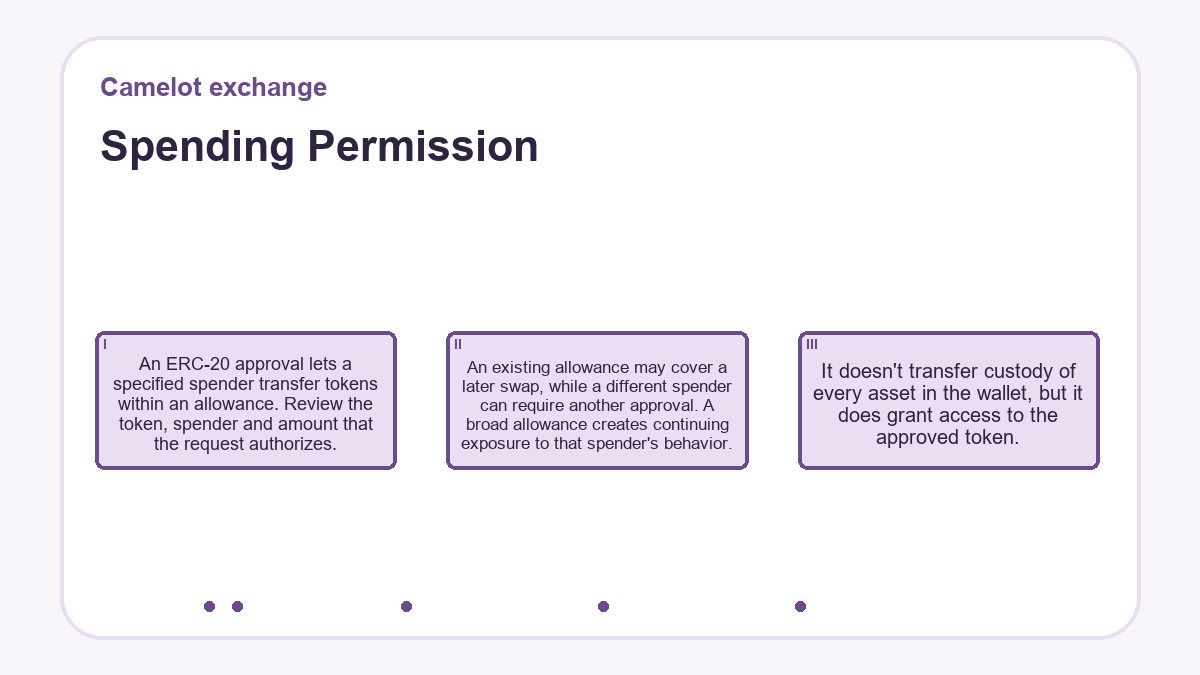
An ERC-20 approval lets a specified spender transfer tokens within an allowance. Review the token, spender and amount that the request authorizes. An existing allowance may cover a later swap, while a different spender can require another approval. A broad allowance creates continuing exposure to that spender's behavior. It doesn't transfer custody of every asset in the wallet, but it does grant access to the approved token.
Swap Authorization
The swap request authorizes trading the specified input under the submitted swap parameters. After broadcast, closing the browser won't withdraw that authorization from the network. A successfully settled swap has no ordinary undo function. Exchanging back requires another trade under the liquidity, fees and prices available then.
Network and Token Identity Determine Spendable Balances
The selected network determines which wallet balances and liquidity pools a Camelot swap can use. Camelot's Arbitrum roots don't make assets interchangeable across every chain that uses Arbitrum technology. A matching wallet address on another network can hold a separate balance that the selected swap cannot spend.
Token identity also includes the contract address on that network. Symbols alone don't establish that two assets are equivalent. The wallet needs the input asset in the relevant environment and enough of the network's gas asset for any required transactions. Switching the wallet's network changes its view; it doesn't move funds between chains. A bridge or supported withdrawal introduces a separate transfer with its own destination and completion conditions.
Pool Versions Change the Available Trading Route
Camelot's pool versions use different pricing designs, which affects the liquidity that a route can access. An automated market maker, or AMM, calculates trades against pooled assets. V2 supports pricing logic for volatile and stable pairs. V3 uses concentrated liquidity and supports fees that respond to volatility and trade direction.
V4 also uses concentrated liquidity, with a modular design based on Algebra Integral. Pool plugins can change fee behavior and other functions. Custom pools can apply different configurations even for the same token pair, so a pair name doesn't fully describe the execution conditions.
Routing therefore belongs in quote review. A version-specific route restricts the pools it uses; aggregation can search a broader set of liquidity. Compare the route that the interface actually presents for the selected network and tokens. A pool's existence doesn't establish that every routing mode supports it.
What Determines the Cost of a Camelot Swap?
A Camelot swap's cost reflects trading fees, network execution charges and the effect of the trade on pool prices. The trading fee compensates participants under the pool's fee rules. Network gas pays for transaction execution, including a separate approval when one is necessary.
Price impact describes how the trade itself moves the execution price through available liquidity. A larger input can produce a worse average rate when it consumes less favorable liquidity. Concentrated pools make the distribution of liquidity across price ranges relevant, so total pool value alone cannot predict the quote for a particular trade size.
Dynamic or directional fees also mean that a familiar pair needn't carry one permanent fee. Compare estimated output for the same input, then account for gas separately. Don't subtract a trading fee twice if the displayed output already includes it.
Minimum Received Limits Acceptable Execution
The minimum received amount sets the output floor for a swap that enforces that parameter. The estimated output remains a quote, while the minimum expresses how far execution may deteriorate before the transaction fails. Slippage tolerance controls the permitted difference around the quote; it doesn't remove price impact.
A swap contract that enforces a minimum output reverts the swap when execution cannot satisfy that minimum. Raising tolerance allows a worse outcome and may make execution possible under changing conditions. It doesn't improve liquidity or guarantee success. A refreshed quote can reveal that the trade no longer meets the intended exchange rate.
The meaningful boundary is the least output that remains acceptable for the proposed input. Set that boundary before submitting the transaction.
The Receipt Connects Execution to the Received Tokens
A successful swap receipt establishes execution, while token transfers and balances explain what the receiving address obtained. A transaction hash alone identifies a submission. It doesn't prove that the swap succeeded, and an approval receipt proves a different operation.
Reconciliation connects the network, transaction type, input amount and output token to the actual transfer records. Compare token quantities rather than relying only on a wallet's currency valuation, which can change independently. Keep gas expenditure separate from the traded amounts, especially when the input asset also pays network fees.
A wallet display can lag behind the chain or omit a token that it hasn't indexed. That display difference doesn't itself justify another swap. The transaction's status and receiving address determine whether the remaining issue concerns execution or balance presentation. Preserve the transaction hash while resolving that distinction.
Providing Liquidity Creates a Different Position
Liquidity provision commits assets to support other traders and creates exposure that continues after the deposit transaction. Camelot supports this alongside swaps. The resulting position represents liquidity ownership rather than a completed exchange into one chosen output token.
Full-Range and Concentrated Exposure
V2 positions provide liquidity across the full price range. Concentrated liquidity lets a provider choose a price range, with the position's asset composition changing as price moves. Once price leaves the range, a manual position stops earning swap fees until trading returns within it. Leaving the range doesn't by itself liquidate the position.
Fees, Incentives and Withdrawal
Trading fees and incentive rewards come from different mechanisms. Camelot's incentive campaigns can apply eligibility rules, so creating a position doesn't establish entitlement to every displayed reward. Fees also don't guarantee that providing liquidity beats holding the original assets. Relative price changes can produce impermanent loss, and withdrawing realizes the position's current composition. A later conversion into a preferred token requires a separate swap.
Transfer Taxes Add Token-Specific Route Constraints
A token's transfer tax can reduce received amounts beyond the pool's own trading fee. Its contract determines which transfers incur the charge. Multiple transfers along an aggregated route can create additional tax exposure, making the route's structure material to the final output.
Camelot's tax-token guidance advises against aggregator mode because a route may incur the tax multiple times. It generally directs users to V2 mode, or V3 in some cases, depending on where the token's liquidity sits. An estimation error alone doesn't prove that a tax exists; volatility can also disrupt estimates. Increasing slippage without identifying the cause can authorize a worse trade while leaving the underlying compatibility problem unresolved. If the route cannot account for the token's behavior, that quote doesn't provide a sound basis for submission.
Alternative Routes and Uses for the Output
A competing route is useful only when it exchanges the same intended assets under comparable conditions. Compare net output, gas requirements and token compatibility for the same input amount. Another DEX may access different liquidity. An aggregator broadens routing choices, while a centralized exchange introduces custody and deposit or withdrawal requirements.
After a successful Camelot swap, the next decision concerns the received token: retain it, transfer it or use it in another supported operation. Each action has fresh prerequisites and costs. A return swap won't reverse the original receipt, and bridging won't relocate the earlier transaction. Start the next decision from the balance and network that now hold the output.
Key questions about Camelot exchange
Does Disconnecting a Wallet Remove Its Token Approvals?
Disconnecting a wallet doesn't revoke an allowance that already exists on the blockchain. It ends the interface connection, while the token contract retains the spending permission. Revoking or reducing that allowance requires a separate authorized operation. Disconnecting also doesn't cancel a swap that the wallet has already broadcast.
Can Sending Tokens Directly to a Swap Contract Complete an Exchange?
A direct token transfer doesn't substitute for calling the contract's swap function. The swap operation supplies instructions such as the route and minimum output. A plain transfer may leave tokens in a contract that has no recovery mechanism for that deposit. Use the supported swap interaction rather than treating a contract address as an exchange deposit address.
Why Can a Failed Swap Still Consume Gas?
A transaction that reaches execution can consume gas even when the contract reverts its token changes. The network has performed computational work, although the swap didn't deliver output. Rejecting a wallet request before broadcast is different. A separately completed approval also remains valid when a later swap fails, because each transaction changes state independently.
Is xGRAIL Available for an Ordinary Token Swap?
xGRAIL is an escrowed token with a redemption process into GRAIL. Transfers are restricted to interactions involving whitelisted addresses, so it isn't an ordinary freely tradable asset. Redemption requires vesting, and choosing a shorter vesting period reduces the GRAIL output. Allocation to a plugin introduces additional rules. Holding xGRAIL therefore requires a different exit decision from holding a token that a liquidity pool can exchange directly.
Does a Token Appearing in a Camelot Pool Establish Its Legitimacy?
A token's presence in a pool doesn't establish its legitimacy or safety. Permissionless pool creation allows participants to introduce assets without a universal endorsement process. Contract identity, transfer restrictions and the ability to sell remain separate concerns. A familiar name or symbol cannot establish those properties.